Value Network Analysis (VNA) is an integrative modelling technique for analysis of business activity (Allee 2003, 2008). It defines the specific roles in a collaboration and their interactions that create value through the exchange of deliverables. Roles and deliverables are made visible through visual graphs. It analysis cost/benefit, value realization, perceived value and internal and external value impact.
The goal of the method is to increase and/or optimize value outputs, to leverage financial and non-financial resources (including intangible assets) for improving financial and organizational performance, to find new value opportunities and to improve operational performance and flows of value.
A Value Network Analysis exercise begins with descriptions of contributing roles and value transactions visualized as a graph or map. Nodes represent roles, and directional arrows between nodes describe transactions. Each transaction has an attribute of tangible or intangible deliverable in the network. Roles are filled by participants in the network, which can be individuals or firms. Multiple participants may be candidates for a role and a participant may play multiple roles.
Typically solid lines indicate contractual, tangible revenue-generating or funding related deliverables and their directional transactions. Dashed lines show the critical intangible or informal deliverables such as knowledge exchanges and conveyed benefits that build relationships and keep things running smoothly.
The figure below, shows a value network for interactions of a technology provider with other business entities. Similar networks describe interactions between roles at different levels of operational detail within a business entity.
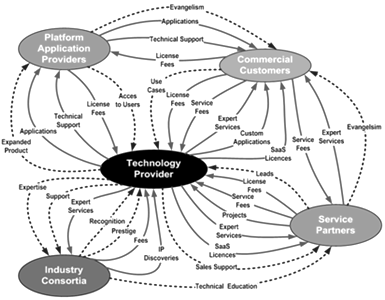
Value Network Map
The table below shows mapping between VNA concepts and VDML concepts. Only corresponding VDML concepts are included in the table. In Annex A of the VDML specification you can find the glossary for further VDML definitions.
| VDML Concept | VNA Concept | Remarks |
|---|---|---|
| Activity | Activity | In VNA, an activity defines the boundary and focus of a value network or sub network and can include multiple actions, roles, deliverables sequences and processes. In VDML the boundary of a network of roles and activities is referred to as a collaboration whereas an activity describes work of a single role within the collaboration. (See activity network below). |
| Attribute | Attribute | In VDML a user-defined, name-value pair associated with a model element. VNA definition is compatible. |
| Channel | Channel | Definitions are the same. |
| Deliverable | Deliverable | Definitions are the same. |
| Intangible | Intangible | Definitions are the same. |
| Measure | Measure | Definitions are the same. |
| Measurement | Measurement | Definitions are the same. |
| Actor | Participant | In VNA Participant and Actor are used interchangeably. In VDML an actor is an entity that does work while a participant can be an actor, a collaboration or a role. |
| Participant | Participant | Definitions are the same. |
| Resource | Resource or Asset | Definitions are the same. In VNA resources may include intangible assets such as human competence, brand, relationships, reputation, and methods. Also see Value Realization. In VDML, resources are conveyed by deliverable flows while measurements of values (e.g., duration and quality) are conveyed by value adds/contributions. In VNA resources are made available to roles, who manage them in regard to the deliverables they are responsible for generating or handling as inputs. In VDML, control of resources is more specific, using stores, activities of roles and deliverable flows. |
| Role | Role | Definitions are the same. |
| Scenario | Scenario | Definitions are the same. |
| Tangible | Tangible | Definitions are the same. |
| Deliverable Flow | Transaction | Concepts are the same. See Process. |
| Value | Value | Definitions are the same. |
| Activity network | Value network | Definitions are compatible. In VNA, a value network depicts interactions of roles and the flow of deliverables between them. In VDML an activity network depicts the activities of the roles (more detail) and the flow of deliverables between them. |
| Collaboration | Value Network | Any collaboration can be modeled as a value network. All value networks are collaborations. In VDML, business network, community, organization unit and capability method are specializations of collaboration. In VDML an activity is distinguished from a collaboration such that an activity can delegate to a shared collaboration. |
| Value proposition | Value realization | In VNA, value realization is when a value input, either tangible or intangible, has a positive impact on or replenishes resources or assets. In VDML a value proposition conveys to a recipient deliverable(s) with a bundle of values that can become inputs to subsequent activities of the recipient. |
Allee, V., The Future of Knowledge: Increasing Prosperity through Value Networks, Butterworth-Heinemann 2003.
Allee, V., Value Network Analysis and Value Conversion of Tangible and Intangible Assets, Journal of Intellectual Capital, Volume 9, issue 1, pp 5-24, January 2008